Big Cats – The most ambassadorial and most beloved of all the species. Sadly, they are listed as Threatened or Near Threatened on the IUCN Red List, with the tiger like Machli (T 16) here from Ranthambhore, categorized as Endangered.
They are not just the apex predators, they are the individuals – the essence. Come, let us rejoice with the ambrosia of their enigmatic legacy on this coming trail of temporality, with all the sincere wishes for 2022…
Photo Courtesy: Sandeep Aggarwal
Download the digital copy from here: One Planet – for the Coming Ones 2022, Series 2
Note: Access the link using your Google account. In case of any error, contact me in the following e-mail ID or phone number (WhatsApp) for the digital copy (absolutely free) —
📧 mahapatrapratik678@gmail.com
📞 +91 7602157355
"In Memoriam," the tribute to Amitabha Guha, rendered by Dipanwita Rakshit
A JOURNEY was eventually commenced last year in the month of December to be evergreen in its flow. As far as I can remember, it took as many as eleven sittings to complete the first series of One Planet – for the Coming Ones. Meant to be the beholder of the essence of Amitabha Guha, our beloved Ujaan Pathik (the Upstream Voyager), One Planet rendered itself to be unique in its first appearance by incorporating holistically almost all the environmental days and weeks, supplemented by the information on special environmental years and decades as well. This time, however, the weaving of the series turned out to be completed within a conspicuous range of five sittings.
Destined to incorporate a number of conservation-based themes and ethos, this year's rendering of the series is essentially oriented on the lives of some of the legendary big cats from the Indian subcontinent, as well as from several African provinces – the iconic tigers, lions, leopards and cheetahs. The theme, being close to my heart, tremendously inspired me right from the beginning of executing the deed. At the very outset, it should be said that there is indeed a galaxy of big cat characters, who, in their own rights, are the deserving individuals to be featured in the worthy projection. Keeping the stipulation of the format of this calendrical presentation in mind (a 16-page deliberation each year), I decided to entune the saga of sixteen individual big cats as the stars of this series. While the front cover of the presentation resonates with the ethos of Machli (T 16) from Ranthambhore Tiger Reserve in the Indian state of Rajasthan, the epitaphial page (since this is an enhanced memoir) relishes the memories of magnanimous Notch, one of the most successful pride males from the wilderness of Maasai Mara National Reserve in Kenya. Both are indeed the heartthrobs of wildlife enthusiasts and big cat lovers all around the world. I sincerely thank Sandeep Aggarwal and my old friend Rich Smith for the respective shots of the front and the back cover of the projection which you may eventually find out from the aforementioned link.
The first one of the twelve core pages, which represent the twelve months of the year, proudly resonates the ambrosia of Ustad (T 24) from Ranthambhore, perhaps the most debated male tigers of an Indian Tiger Reserve and whose mentions are now to be figured out in orientations of some conscientiously concerned activists. Nilanjan Roy Chowdhury, being a regular visitor of Ranthambhore Tiger Reserve, has closely followed the rise and fall of Ustad ever since he was a small cub back in 2005. Personally, it is a great feeling for me to incorporate his shot over here in this presentation. The next two pages, respectively, focus on the notorious and Satanic Mapogo Coalition of male lions from Sabi Sand National Park in South Africa, and Kamli (T 11) the tigress from Sanjay-Dubari Tiger Reserve in Madhya Pradesh. I rendered an enhanced article on Kamli this year on International Tiger Day in my blog The Wild Tales: Secrets of Sylvan Eyes. Jairaj Singh Parihar turned out to be the person who thoroughly guided me about all contextual information about Kamli. Thanks again to him for extending his solidarity again in terms of sharing one of his clicks of Kamli, the real survivor. However, the shot of Mapogos is from a website of Pembury Tours (reusing permitted).
In all these months of conspicuously concentrating on the series review of Big Cat Diary over there in The Wild Tales, one person from the core of this massive endeavour turned out to be the most desired beacon of inspiration – Jonathan Scott, who himself was one of the presenters of the series. Earnest thanks to him and Angela Scott, whose spell bounding frames have been enchanting me ever since I started to be engrossed in this domain of wildlife and conservation as an enthusiast. Three of the cats of Mara, who happened to be the essential part of their life, are here in this series of One Planet – Half-Tail and Zawadi (who is rather known as Shadow for Big Cat Diary audience), the iconic leopards and Kike the cheetah, the "Mother Courage" of Mara. All are stunning individuals in their own rights, tenacity and tenderness.
We are destined to figure out the representation of Legadima the leopard from Botswana's Okavango Delta, Mataram or Collarwali from Pench Tiger Reserve and Lady Liuwa from Zambia's Liuwa Plains National Park, and Maya the tigress (T 12) from Tadoba-Andhari Tiger Reserve in Maharashtra. All of them essentially turned out to be the trendsetters of wildlife conservation. Humbly acknowledging here the contributions of Derek and Baverly Jourbert, Omveer Choudhary, Archive Legend and Legacies (reusing permitted) and Advait Sakhalkar. Furthermore, the parallel contributions of two pioneering pillars – John Varty (JV) from Londolozi Game Reserve in South Africa and Billy Arjan Singh from Dudhwa Tiger Reserve in the Indian state of Uttarakhand taught us the dimensions of rearing big cats and relocating them into the wilderness. The 2022 series of One Planet is embellished with the incorporations of Shingalana the lioness and Harriet the leopard too, highlighting their ethos of resilience. Finally, thanks to Surendra Singh Chouhan for gladly allowing to incorporate his magnanimous frame of Tano Bora, the famous Five Cheetah Boys from the Mara. All the characters indeed made this series of One Planet to be really special! This year, it is more special since through the presentation of each cat, a coherent literary scenario (fictional and non-fictional) is duly captured.
Finally, the mention of the two persons – one happens to be the genesis of this entire endeavour, Dipa Aunty (Dipanwita Rakshit) and Sneha (Sneha Biswas), who set forth the emblematic identity forever. The bridge up that we three had for this series and the last one is truly remarkable!
“:they told me I was everything: ‘tis a lie, I am not ague-proof.”
— William Shakespeare, King Lear (Act IV, Sc. vi)
Ustad (T 24), the banished Lear of Ranthambhore, enjoying his prime
Photo Courtesy : R. C. Nilanjan, 2014
“What though the field be lost?/ All is not lost : the unconquerable will, / And study of revenge, immortal hate,/ And courage never to submit or yield : "
— John Milton, Paradise Lost (Book I)
The notorious and Satanic Mapogo coalition, the fallen angels of Sabi Sand National Park, South Africa
Photo Courtesy : Pembury Tours, 2010
“It’s much better this way. To have acted it out to show them, although I could not have planned it.”
— Ama Ata Aidoo, “The Girl Who Can”
Kamli (T 11) from Sanjay-Dubari Tiger Reserve in Madhya Pradesh - the girl who could, embodied with the winning spirit
Photo Courtesy : Jairaj Singh Parihar, 2021
“They are still the darkness in the grass, the eyes that watch you go by but remain for the most part unseen. Unless of course you are prepared to spend the next thirty years of your life setting about unravelling their secrets.”
— Simon King, Forewords to The Leopard’s Tale
Retelling the tales of Half-Tail and Zawadi (Shadow), the stars of Big Cat Diary in the Leopard Gorge in Maasai Mara National Reserve, Kenya
Photo Courtesy: Jonathan and Angela Scott, 1996
“Hawks for sunlight, owls for half light, but for the nights, cats, wild cats…”
— Dorris Lessing, On Cats
Legadima in the heart of darkness in Okavango Delta, Botswana, featured in Eye of the Leopard
Photo Courtesy: Derek and Baverly Joubert, 2006
“Selflessness is a rare virtue, because it doesn’t pay for itself.”
— Bertolt Brecht, Mother Courage and Her Children
Commemorating Kike, the Mother Courage of Maasai Mara, Kenya posing on the vehicle of Jonathan Scott
Photo Courtesy : Jonathan and Angela Scott, 2003
“When you are a mother, you are never really alone in your thoughts. You are connected to your child and to all those who touch your lives. A mother always has to think twice, once for herself and once for her child.”
— Sophia Loren
Mataram or Collarwali (T 15), the supermom and legendary matriarch from Pench Tiger Reserve, Madhya Pradesh
Photo Courtesy: Omveer Choudhary, 2020
“An understanding of the natural world and what’s in it is a source of not only a great curiosity but great fulfilment.”
— David Attenborough
Lady Liuwa and Herbert Brauer, weaved in understanding in the frame of fulfilment in Liuwa Plains National Park, Zambia
Photo Courtesy: Legend and Legacies, 2009
“She wins two boons from the encounter: her own virgo intacta and special powers for her son.”
— The Mahabharata
Maya (T 12), the epitome of mystic mother from Tadoba-Andhari Tiger Reserve, Maharashtra
Photo Courtesy: Advait Sakhalkar (advait-s.com), 2016
“We drove toward them until we could see the glint of three pairs of eyes. There was nothing more to be done. So, with heavy hearts, we turned for home. Would Elsa be killed by a jealous lioness?”
— Joy Adamson, Born Free: A Lioness of Two Worlds
Shingalana, the reincarnation of Elsa with John Varty (JV) and Gillian Van Houten in South Luangwa National Park, Zambia
Photo Courtesy: Elmon Mhlongo (John Varty Alive Archive), 1996
“Now you are a beauty!” said the Ethiopian. “You can lie out on the bare ground and look like a heap of pebbles. You can lie out on the naked rocks and look like a piece of pudding-stone. You can lie out on a leafy branch and look like sunshine sifting through the leaves; and you can lie across the centre of a path and look like nothing in particular. Think of that and purr!”
— Rudyard Kipling, How the Leopard got his Spots
Billy Arjan Singh with his reared leopard, Harriet on the balcony at Tiger Heaven
Photo Courtesy: Lisa Choegyal (Nepali Times), 1975
“The problem is not the problem, the problem is your attitude about the problem.”
— Jack Sparrow from Pirates of the Carribean
Tano Bora or the Five Cheetah Boys, the pirates from the Maasai Mara, Kenya scanning the horizon
Photo Courtesy: Surendra Singh Chouhan, 2017
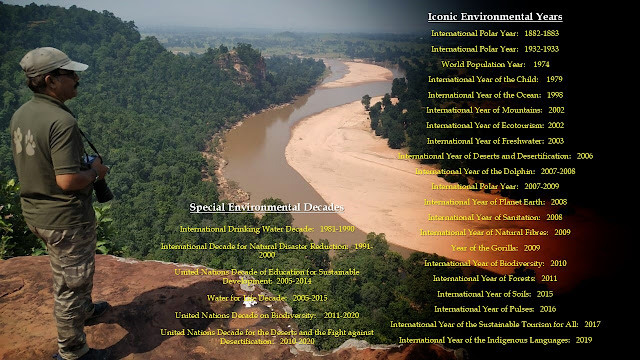
The list of iconic environmental years and decades
Ujaan Pathik, the begetter of this holistic rendering always believed that these mighty felines are not merely the species of our chief concern, they are the individuals; the distinct characters of real life drama as played out on the stage of the earth. They are the entities whose tenacious events, as Keith Scholey says, ‘would rival any Shakespearean plot’. They, by the virtue of their invigoration and tenderness; valour and care, have been enchanting our hearts over the decades. This series of One Planet- for the Coming Ones, thus, turns out to be a humble tribute , allying the attributions of those hearts, who care are revere the magnanimity of their grace. The epitaphial template rejoices the memories of mighty Notch, one of the most successful pride males from the wilderness of Mara, the kingdom of predators, showcasing his immortal frame, captured by Rich Smith in 2012. Let us be proximate for the service to Nature.
One Planet- for the Coming Ones — A tribute to the loving memories of Amitabha Guha, our beloved Ujaan Pathik
Those who made One Planet a reality
Concept
Dipanwita Rakshit
Theme, Research, Compilation and Illustration
Pratik Mahapatra
Emblem of One Planet
Sneha Biswas
Front Cover Shot
Sandeep Aggarwal
Contributors
R. C. Nilanjan, Pembury Tours, Jairaj Singh Parihar, Jonathan and Angela Scott, Derek and Baverly Joubert, Omveer Choudhary, Legend and Legacies, Advait Sakhalkar (advait-s.com), Elmon Mhlongo (John Varty Alive Archive), Lisa Choegyal (Nepali Times), Surendra Singh Chouhan
Back Cover Shot